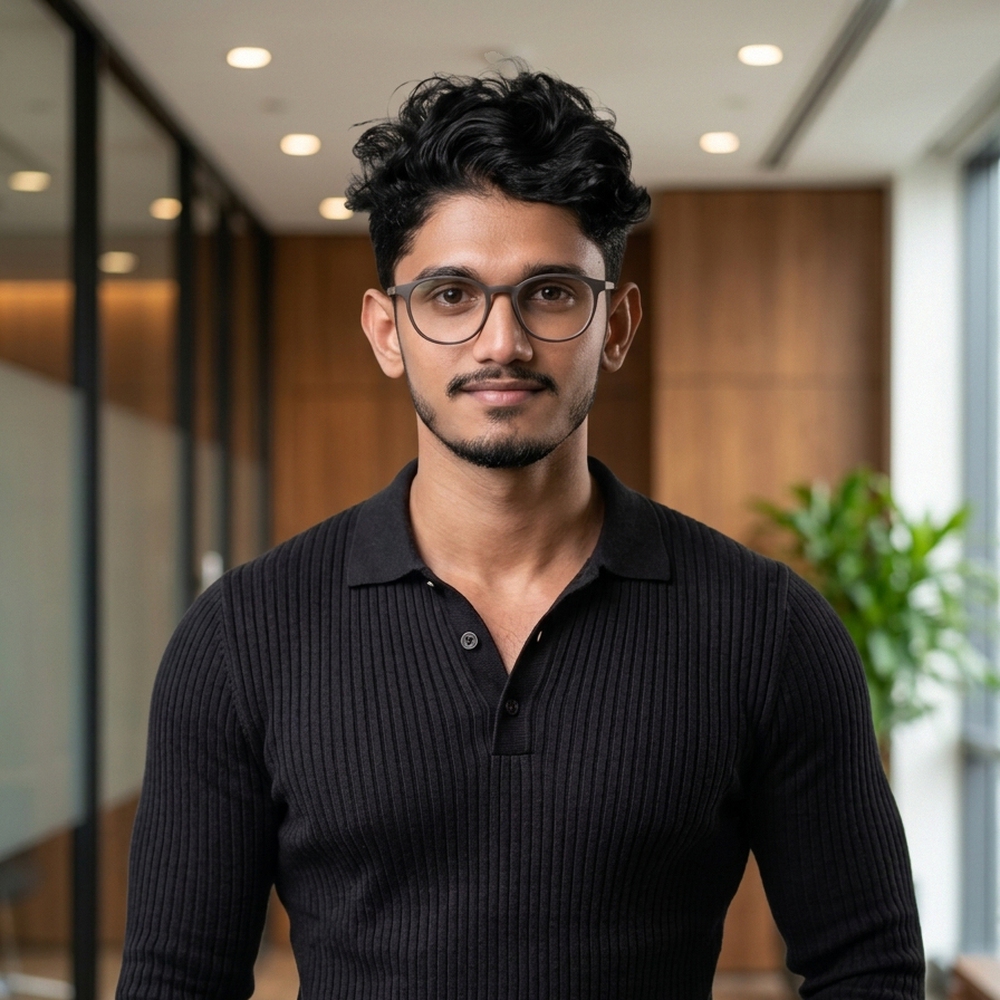
About Me
I am an independent computer science researcher living and working in Pune, India. My research lives at the intersection of mathematical machine learning—specifically understanding how language models actually learn to reason through reinforcement learning—and building fault-tolerant distributed consensus infrastructure that holds up under severe real-world network stress.
In 2024, I graduated with a B.Tech. in Artificial Intelligence and Data Science from Savitribai Phule Pune University (APCOER Pune), finishing First Class with Distinction with an 8.70 cumulative GPA and a 9.53 final year SGPA (Rank 1). That rigorous mathematical grounding continues to direct every problem I choose to work on.
Research Focus & Philosophy
I am drawn to questions where standard empirical assumptions quietly break down when inspected carefully.
In modern post-training and reinforcement learning with verifiable rewards (RLVR), the community widely assumes that token-predictive entropy works as an effective proxy for model uncertainty. In my recent work, I set out to test whether that assumption actually holds. It turns out that predictive entropy correlates strongly with sequence length (r = +0.486)—meaning that uncertainty-weighted credit assignment methods (like entropy-weighted GRPO) end up misallocating reward gradients simply because a correct mathematical derivation required more steps. We formulated length-invariant credit assignment estimators (ear_grpo_reasoning) and state-matched difference-in-differences counterfactual evaluation protocols (recovery_eval, stateshift) to measure whether models genuinely recover from intermediate reasoning errors when structural covariates are held frozen.
On the systems side, I care just as much about runtime reality as theoretical elegance. When distributed consensus protocols encounter asymmetric network partitions or non-uniform round-trip times, conventional static quorums suffer crippling tail-latency blowups. To solve this, I designed failure-domain aware dynamic quorum adaptation algorithms and spectral latency estimators in C++20 for Raft consensus clusters (quorumshift), proving non-empty intersection invariants without ever violating safety or linearizability.
My general rule of thumb is simple: work out the math on paper first, identify the falsifiable hypothesis, and then write the low-level code and stress-test benchmarks to see if the hypothesis survives contact with reality.
The Human Side: Athletics, Community & Life
Sustained research requires physical energy and a clear head. I am a competitive runner, specializing in sprints and distance running, and won the Gold Medal in Athletics at the 2023 Inter-College Athletic Meet. Most of my toughest algorithmic roadblocks get untangled while out on early morning runs across Pune's hills before the city wakes up.
During my final undergraduate year, I was elected President of the Social Volunteer Organization at APCOER. We ran weekly volunteer tutoring programs for underprivileged high-school students across Pune district, teaching them foundational algebra, arithmetic, and basic digital literacy. We also organized city-wide blood donation camps and local environmental sustainability campaigns. Sitting side-by-side with young students who had never owned a computer and watching them solve algebraic equations for the first time remains one of the most meaningful things I have done.
When I am away from terminal windows and LaTeX manuscripts, you will usually find me reading classical computer science literature, drinking strong tea, or exploring Pune's historic neighborhoods with a notebook and fountain pen.
Formal / Colloquium Bio
"Sham Satish Thakare is an independent computer science researcher based in Pune, India, investigating foundation model reasoning reliability, reinforcement learning credit assignment (RLVR), and fault-tolerant distributed consensus systems. He holds a B.Tech. in Artificial Intelligence & Data Science (First Class with Distinction) from Savitribai Phule Pune University."